

Early Childhood Special Education
Do You Know a Preschooler Struggling to Learn?
Children grow and develop at different rates, but most will reach several milestones between the ages of 3 and 5. A child who is not meeting milestones or struggling to learn may need additional supports to help them prepare for kindergarten.
Concerns that could potentially impact a child's ability to learn include:
- Difficulties with speech or language
- Cognitive impairment
- Autism Spectrum Disorder (ASD)
- Emotional concerns
- Traumatic brain injury
- Hearing or visual difficulties
- A developmental delay or specific learning disability
Special education programs and supports are available to children ages 3, 4, and 5 through the local school district. Early intervention helps keep children on a path to learning.
What Are Preschool Services and Where Are They Located?
Michigan Early Childhood Special Education (ECSE) services include special instruction and related services for children, ages 3 through 5, who qualify under the Individuals with Disabilities Act (IDEA, Part B, Section 619). A Free and Appropriate Public Education (FAPE) is offered to all eligible children (at no cost), in the Least Restrictive Environment (LRE). LRE means that young children with disabilities should get services in community-based preschool settings and programs whenever possible.
Who Is Eligible?
Children ages 3 through 5, with a disability defined by one of the following categories, are eligible for special education services:
- Speech/Language Concerns
- Specific Learning Disability
- Cognitive Impairment
- Autism Spectrum Disorder
- Emotional Impairment
- Traumatic Brain Injury
- Hearing Impairment
- Visual Impairment
- Severe Multiple Impairment
- Early Childhood Developmental Delay (ECDD)
- Other Health Impairment (including attention deficit disorder and health problems such as asthma, epilepsy, and diabetes)
How Do Children Access Special Education Preschool Services?
Children who are receiving early intervention services may begin special education preschool services:
- Upon transitioning out of early intervention, typically at age 3;
- At the State of Michigan's discretion, children who are age 2, but will turn age 3 during the school year may receive special education preschool services.
- Some children are eligible for services between the ages of 2 and 5, and may begin services as preschoolers.
It is common to learn a child may need special services while at well-baby or well-child visit. It is also common for a childcare provider or preschool staff to express concerns regarding a possible developmental or learning delay.
If there is a concern, a comprehensive evaluation can be done to determine if the child has a significant delay or disability and needs specialized services. Anyone can submit a referral for a free evaluation through Early On of Michigan. The evaluation covers a range of areas such as vision and hearing, gross and fine motor skills, speech and language use, social and emotional behavior, and more. Contact Ingham ISD at 517.244.4514 for additional information.
Resources
Following are helpful resources for families, childcare providers, and educators:
- Build Up Michigan For families, with children ages 3 through 5, to receive additional educational support for kindergarten entry.
- Parent Training and Information (PTI) A list of state-by-state parent resource centers.
- Division for Early Childhood (DEC) Through the Council for Exceptional Children dedicated to improving the educational success of individuals with disabilities and/or gifts and talents.
- Specific Disabilities such as United Cerebral Palsy (UCP) or Autism Society.
Learning Together in Inclusive Preschool Classrooms
About Our Inclusive Classrooms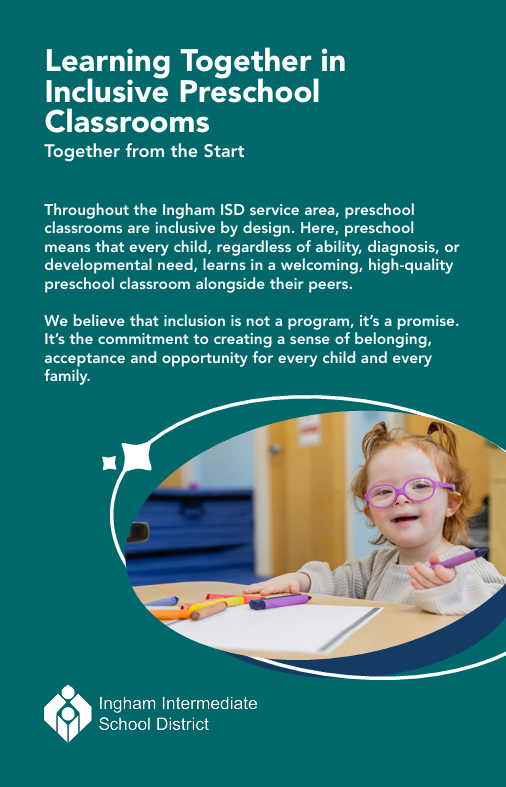
Throughout the Ingham ISD service area, preschool classrooms are inclusive by design. Here, preschool means that every child, regardless of ability, diagnosis, or developmental need, learns in a welcoming, high-quality preschool classroom alongside their peers. We believe that inclusion is not a program, it’s a promise. It’s the commitment to creating a sense of belonging, acceptance and opportunity for every child and every family.
Inclusive classrooms help all children thrive.
Why It Matters
Inclusion is backed by research and results.
- Children with disabilities who attend inclusive classrooms make greater gains in communication, social skills and learning
- Children without disabilities benefit from learning alongside diverse peers - building empathy, leadership and teamwork
- Early inclusion lays the foundation for lifelong relationships and community participation
What Does Inclusion Look Like?
In preschool classrooms, we focus on three key features:
Access: We ensure that all children can physically, socially and emotionally participate by adapting our classrooms, materials and routines.
Participation: Help every child actively engage in learning, play and peer interactions.
Supports: Teachers collaborate with special education staff, therapists and families to ensure every child is supported and included.
What Makes it High-Quality Preschool?
Our inclusive preschool classrooms follow national best practices to ensure a strong start for all children. This includes:
- Nurturing, responsive teacher-child relationships
- Curriculum that supports social, emotional, physical, cognitive and language growth
- Developmentally appropriate and engaging activities
- Regular assessment to tailor learning to each child
- Healthy, safe and welcoming environments
- Deep, ongoing family engagement
- Teachers and support staff trained in inclusive practices
“Seeing our child thrive alongside their peers has been incredible. They learn, play, and grow together every day, building friendships and confidence in a classroom where everyone belongs.” - Shannon G., Parent
“The teachers and support staff truly know our child and our family. They work together to meet our child’s needs, communicate with us, and make sure we feel supported every step of the way.” - Jake M., Parent
Download info on Inclusive Classrooms here.


