
Services
Adaptive Physical Education Teacher
Our Adaptive Physical Education Teacher (ADPE) provides developmentally appropriate physical education at its finest. It involves differentiating instruction so the physical activity is as appropriate for the person with a disability as it is for a person without a disability. This role includes swim instruction in Heartwood School's heated pool.
Classroom Compliance
Heartwood currently has 15 classrooms that services students ages 3-26 in the following classroom designations as are found in the Michigan Administrative Rules for Special Education Supplemented with IDEA Federal Regulations:
- R 340.1738 Severe cognitive impairment program
- R 340.1739 Programs for students with moderate cognitive impairment
- R 340.1748 Severe multiple impairments program
- R 340.1758 Autism Spectrum Disorder
Placement in specific classrooms are determined each year dependent on age, functioning and IEP determinations.
Heartwood Staffing
All Heartwood teachers are all highly qualified and provide outstanding diverse, educational opportunities and experiences for all learners. Each classroom is supported by skilled paraprofessionals who support the daily learning and functioning of each and every student. In addition to classroom staff, Heartwood students benefit from a variety of related service providers as determined on student IEP's.
Music Therapy
Music therapy is the professional use of music and its elements as an intervention in medical, educational, and everyday environments with individuals, groups, families, or communities who see to optimize their quality of life and improve their physical, social, communicative, emotional, intellectual, and spiritual health and wellbeing. Research, practice, education, and clinical training in music therapy are based on professional standards to cultural, social, and political contexts" (World Federation of Music Therapy, 2011).
Occupational Therapy
A full time Occupational Therapist and Occupational Therapist Assistant evaluate, consult, monitor and or treat students in the following areas:
- Sensory Processing Skills
- Accommodations in the Educational Setting
- Components of Movement
- Assistive Technology
- Self-Care Skills
- Adaptation of Equipment
- Pre-Vocational and Vocational Skills
Specific Roles Of Occupational Therapy Staff-
Occupational therapy staff evaluate, consult, monitor and/or treat students in the following areas: Educational Training - The goal is to build capacity in the educational setting with ongoing educational training to empower families, teachers, and other school staff to meet the educational needs of all students.
Sensory Processing Skills - Include (but may not be limited to): sensory integration, perceptual motor, reflex development/integration, oral motor, self-regulatory, and readiness abilities as foundations for sensory processing skills as appropriate to the learning environment. Accommodations in the Educational Setting - Assessment and implementation of strategies which accommodate the learning needs as well as the physical environment, such as in classrooms, hallways, restrooms, lockers, playgrounds, and cafeterias.
Components of Movement – Development of head and trunk control for fine motor and bilateral skills, motor planning, and coordination of body parts for purposeful and skilled movement as appropriate to the learning environment. Assistive Technology - OTs work with a team to assist in the educational setting to adapt and/or make recommendations for low tech as well as high tech equipment for the purpose of educational benefit. Self-Care Skills - Include (but may not be limited to): feeding, dressing, hygiene, toileting, oral-motor, communication, and regulatory skills to participate in activities as appropriate to educational goals and objectives.
Adaptation of Equipment – Design, construction, and modification of splints and equipment for functional use (i.e. writing, dressing, feeding), and training in use of upper extremity prostheses; recommendations for positioning, wheelchairs, hand splints, upper extremity braces, transportation, and seating devices as appropriate to the learning environment.
Pre-Vocational / Vocational Skills - Manual dexterity, strength, endurance, physical capabilities, adaptive methods, and equipment as appropriate to the learning environment. *Note: The practice of Occupational Therapy does not include identifying underlying medical problems or etiologies, establishing medical diagnoses, or prescribing medical treatment.
Physical Therapy
A Physical Therapist and Physical Therapist Assistant are highly quaulifed to meet the very unique mobility needs of students at Heartwood School. The school fully encompasses MOVE® and has become a model site in the state of Michigan.
POSITIVE BEHAVIOR SUPPORTS
Heartwood's school wide rules are Be Safe, Be Kind, Be Learning. 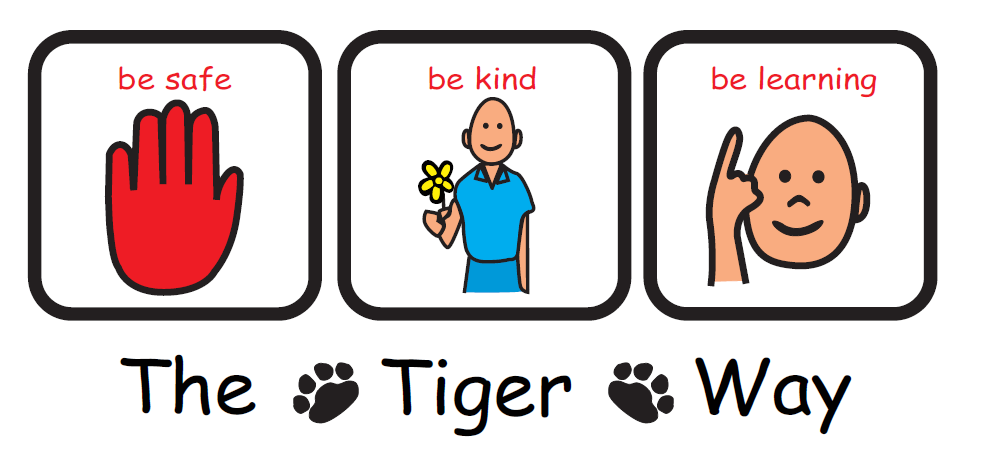
At Heartwood School, fostering safe and positive behavior is at the core of our educational philosophy. We believe in creating a nurturing environment where every student can thrive. Here's how we do it:
- Visual Reinforcement: Classrooms and hallways have visuals that serve as constant reminders of the behavioral expectations. These visuals help students and staff stay on track with our rules and values.
- Positive Reinforcement: Our staff actively engage with students by reinforcing positive behavior and issuing "Tiger-Way Tickets" as tokens of recognition. Students can accumulate these tickets and redeem them at the Heartwood School Store for exciting prizes or snacks, promoting a culture of encouragement and motivation.
Heartwood has two teams dedicated to fostering safe and positive behavior:
- The Behavior Intervention Team comprises proactive staff members who collaborate closely with classroom personnel to provide Tier 1 and Tier 2 support within both classroom and school settings. Check out what Tier 1, Tier 2 and Tier 3 mean here: Center on PBIS
- The Crisis Response Team is composed of trained staff members equipped with CPI Certification, dedicated to fostering safe environments and responding effectively to situations requiring additional student supports.
Behavior Specialist:
Heartwood employs a dedicated full-time Behavior Specialist whose primary responsibility is to foster a supportive and safe environment by promptly addressing behavior situations within the building. Additionally, the Behavior Specialist collaborates with therapy centers, including ABA, to facilitate effective interventions. They also provide comprehensive support to families navigating maladaptive behaviors, utilize data analysis to identify behavioral patterns, and implement evidence-based strategies to cultivate a positive learning atmosphere.
Social Worker:
Heartwood School has a full time school scoial worker, The school social worker is responsible for providing evaluations, consult services, direct services and assisting with students and families over multiple areas. Some of the areas the school social worker assists with are the social emotional regulation, social/emotional skills, behaviors, community resources (Greater Lansing food bank, CMH, old news boys, etc.), coordination of services and support for students and families inside and out of the classroom.
School Nurse
Two Full-Time School Nurses-
At Heartwood School, our school nurses and health clinic play a vital role in supporting the well-being of our students. We provide specialized healthcare services tailored to meet the needs of students in our center-based education program, including those with physical, developmental, and medical challenges. Our clinic ensures the safe administration of medications and tube feedings, monitors chronic health conditions, responds to medical emergencies, and collaborates with parents and staff to create individualized health plans. We are committed to creating a safe and healthy environment, helping each student thrive both in and out of the classroom.
School Psychologist
Heartwood School is served by a school psychologist. Our school's psychologist has the necessary training and expertise to assist parents and teachers in their efforts to maximize student outcomes.
Speech and Language Therapy
Developing functional communication skills is crucial for success in the academic setting, home, and community. Each students communication abilities are unique. Students are encouraged to develop multiple modalities to communicate effectively across their life experiences. Staff use evidence-based principles to promote this communication development.
Augmentative and Alternative Communication (AAC) refers to communication devises, systems, strategies, and tools that can supplement or replace spoken language. These tools support a person who has difficulties communicating using exclusively speech. (See pictures below.)
Aided Language Input (ALD) is a communication strategy which requires a communication partner to teach symbol meaning and model symbolic communication by pairing speech with graphic symbols or other forms of AAC. Staff are encouraged to utilize Aided Language Input while communicating with students to promote growth of language and speech through Core and Fringe Vocabulary. It is an AAC immersion approach!
CORE Vocabulary is a small set of simple words, in any language, that are used frequently and across contexts. CORE makes up about 75% of what adults and children say. Heartwood emphasizes CORE vocabulary to provide more robust communication that translates across age, environments, activities, and communication partners.
FRINGE Vocabulary is a large set of specific words that have concrete meanings. FRINGE makes up about 25% of what adults and children say. The intent of FRINGE Vocabulary is to provide more specificity to language.


